Duda Website Builder Review 2026: Pricing, White Label & SEO
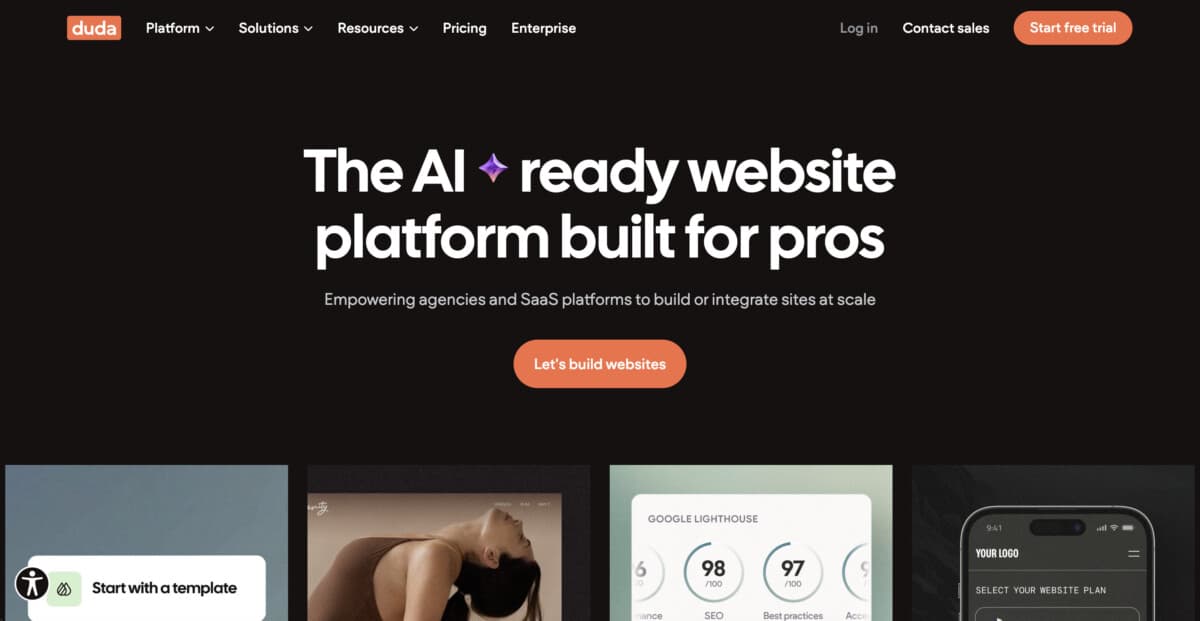
Duda is a website builder made for people who build sites for other people: agencies, freelancers, and SaaS or hosting companies that want to offer websites under their own brand. If you need one personal site, it is usually not the cheapest or simplest choice. If you build and look after many client sites, it is one of the strongest platforms in the market.
This Duda website builder review was updated in November 2026. It covers what Duda costs in practice (not just the plan names), what the white label setup actually hides, how well Duda sites can be optimized for Google and AI search, ecommerce and bookings, where to hire a Duda designer, and how it compares with Wix, Webflow, Squarespace, Durable and WordPress. All prices come from Duda’s official pricing page and business plans page, checked on 2 November 2026. You can also see Duda’s entry in our directory at Duda on websitebuilders.directory.
Quick verdict
- Best for: agencies and freelancers who ship client sites regularly, and companies that want to resell a website builder under their own brand.
- Price: account plans from $25/mo ($19/mo billed annually), with extra published sites from about $14/mo each on annual billing.
- Standout strengths: client permissions, reusable templates and sections, full white label on the White Label plan, and strong technical SEO handled for you.
- Main drawbacks: the pricing model takes a minute to understand, stores and bookings cost extra on paid tiers, and it is overkill for a single DIY site.
What is Duda?
Duda is a cloud website builder with a drag-and-drop editor, Duda-managed hosting on Amazon Web Services, and a set of tools for running many sites from one dashboard. Your account plan unlocks platform features such as team seats, client accounts and white labeling. Each published site is then counted as a project, and your plan includes a set number of them. That split between the account and the sites is the key thing to understand about Duda, and it is why the platform feels more like an agency tool than a consumer builder.
Duda also now includes Duda Vibe, which generates client-ready sites and simple web apps from prompts, plus an AI widget builder, AI content tools and an MCP server so you can connect outside AI tools to the platform. These sit on top of the classic editor rather than replacing it.
Who Duda is for (and who should skip it)
Duda fits best if you are one of these:
- Web design and marketing agencies that produce many sites and want shared templates, team seats and clean client handoff.
- Freelancers who build client sites often enough that reusable sections and client permissions save real time.
- SaaS platforms, hosting companies and point-of-sale providers that want to offer websites to their own customers under their brand.
- Multi-location businesses that need dozens of similar sites kept consistent.
Skip it, or at least trial it carefully, if you only want one personal or small business site you will edit yourself. A consumer builder such as Wix or Squarespace will be simpler and often cheaper for that. If you need large-catalog ecommerce, a dedicated store platform is still the safer default.
Duda pricing in 2026
Duda pricing has three layers: the account plan, the published projects (sites), and optional upgrades such as stores, bookings and AI visibility tracking. Prices below are in USD per account.
Account plans
- Basic: $25/mo monthly, or $19/mo billed annually. One included published project and email support. Saved custom templates and sections start on Team.
- Team: $39/mo monthly, or $29/mo billed annually. One included project, 3 team seats, unlimited client accounts with role-based permissions, up to 2 custom templates and 5 custom sections.
- Agency: $69/mo monthly, or $52/mo billed annually. Four included projects, 6 team seats, up to 5 custom templates and 15 custom sections, and email, chat and screen-share support. Duda labels this its best value plan.
- White Label: $199/mo monthly, or $149/mo billed annually. Four included projects, 6 team seats, the white-label experience, a custom platform domain and API access.
- Custom: priced through sales, with custom limits, advanced compliance, a dedicated account team and volume pricing.
Annual billing saves 25% and is charged upfront. Every paid plan includes 150 AI credits a month, unlimited storage and bandwidth, AWS hosting and a free domain for the first year. Duda offers a 14-day free trial with White Label features and no credit card, plus a 30-day money-back guarantee on eligible plans.
Extra sites, stores and bookings
Once you use your included projects, each extra published site needs its own subscription. Duda’s business plans page says additional Core site plans start at $14/mo when you are on Team, Agency or White Label and pay annually ($14.25 on Basic), and $17/mo on monthly billing. The Core site plan already includes basic marketing automation (50 emails a month) and one bookings calendar.
If a client site needs a store, more email or SMS reminders, the site moves up a business plan:
- Standard: $8/mo ($7/mo annually). 100 products, 10,000 emails and 100 SMS a month, 1 bookings seat.
- Advanced: $22/mo ($20/mo annually). 1,000 products, digital products and subscriptions, automated shipping and tax, 3 bookings seats.
- Elite: $52/mo ($45/mo annually). 20,000 products, 150,000 emails and 500 SMS a month, 10 bookings seats.
Duda charges 0% transaction fees on these store plans; you still pay your payment provider (Stripe, PayPal, Square, Authorize.Net or Mollie).
AI Visibility add-on
Duda sells tracking of how often client brands show up in ChatGPT, Gemini, Perplexity and other AI answers as a separate add-on: Starter $19/mo (1 domain), Growth $39/mo (5 domains), Professional $89/mo (10 domains) and Scale $195/mo (20 domains). It is free for the first 14 days. Most small agencies can skip it at first.
What a Duda website actually costs
Here is how the list prices above add up for three common setups, using annual billing. These are simple sums of Duda’s published prices, not quotes, and taxes may apply.
- Freelancer with one client site: Basic at $19/mo covers the account and its one included site, so about $228 a year.
- Small agency with 10 client sites: Agency at $52/mo includes 4 sites; 6 more Core site plans from $14/mo each add about $84/mo, for roughly $136/mo in total. If two of those clients need a store on the Advanced plan, budget about $20/mo for each store site.
- Branded reseller with 30 sites: White Label at $149/mo includes 4 sites; 26 more from $14/mo each add about $364/mo, so roughly $513/mo before you add your own margin. At this size it is worth asking sales about Custom volume pricing.
The practical takeaway: the plan price matters less than your site count. Agency usually becomes the better deal once you have more than one or two live client sites, because the three extra included sites cover most of its higher price.
Editor, templates and AI tools
Duda’s editor is responsive by default, with separate desktop, tablet and mobile views, drag-and-drop sections, and optional HTML and CSS access when you need it. Sites can have up to 1,000 pages, unlimited form submissions, multi-language support, personalization rules and connected data for dynamic pages.
The real time-saver for agencies is reuse. From the Team plan up, you can save your own templates and sections (limits rise with the plan) so every new client project starts from your own system instead of a blank page. Client content collection lets clients upload their text and images into the project before you build, which cuts a lot of back-and-forth email.
On the AI side, Duda can generate sections, multi-page sites, copy, translations and image alt text, and its widget builder can create custom widgets from a prompt. Treat the output as a first draft; you will still edit copy and layout for real clients.
Duda white label and reseller features
White label is the main reason many companies choose Duda, so it helps to know exactly what changes. On the White Label and Custom plans you can show the following under your own brand:
- The website editor and the multi-site dashboard, with your logo, colors and your own platform domain.
- A branded client login screen and client dashboard where clients edit content and see site stats.
- Website preview pages and platform emails, such as weekly or monthly stats reports to clients.
- An unbranded self-service support portal for your clients.
- Client billing, so you can collect one-time and recurring payments through the platform under your brand.
A branded template gallery is reserved for Custom plans. Lower plans still let you invite unlimited clients with granular permissions, so a freelancer can hand off editing access without white labeling. For bigger resellers, Duda’s REST API (documented at developer.duda.co) can create sites, sync business data from a CRM, and manage client and team accounts automatically.
If you plan to resell websites, compare the White Label plan’s $149 to $199 a month against what you will charge per site. With a few dozen paying clients, the branding and client billing usually pay for themselves; with five clients, Agency plus plain client permissions is often enough.
Can you optimize a Duda website for SEO?
Yes, and much of the technical work is done for you. According to Duda’s SEO documentation, every site gets:
- Server-side rendering, so search engines and AI crawlers see plain HTML instead of heavy JavaScript.
- Automatic schema for business info, FAQ pages, videos, products, blog posts and more, with the option to add your own.
- Automatic canonical tags (you cannot edit the canonical, by design), 301 and 302 redirects, and alerts when a change may need a redirect.
- Sitemaps shared through IndexNow every time you publish, plus an automatically generated LLMs.txt file for AI tools.
- Hreflang tags on multi-language sites, free SSL, Open Graph controls and page-level meta tags.
- A site performance dashboard that flags broken links and missing alt text, with Google Search Console integration.
What Duda will not do is rank a site on its own. To optimize a Duda website you still need to:
- Pick one main search phrase per page and use it naturally in the page title, H1 and opening paragraph.
- Write unique titles and meta descriptions instead of leaving template defaults.
- Compress large hero images and fill in alt text (the bulk AI alt-text tool helps here).
- Build location or service pages with real, specific content rather than near-duplicates.
- Connect Search Console, submit the sitemap, and fix anything the performance dashboard flags.
- Earn links and reviews; no builder can do that part.
Duda says its sites lead the industry on Google’s Core Web Vitals. We have not run our own speed benchmark, so treat that as Duda’s claim, but the server-side rendering and clean markup are real advantages over heavier template platforms.
Hosting, security and reliability
All Duda sites are hosted by Duda on Amazon Web Services with the CloudFront CDN. Duda states a 99.5% uptime guarantee, unlimited bandwidth and unlimited storage on every plan, and automatic DNS configuration for up to five sites on standard plans. You do not manage servers, updates or plugins, which removes the maintenance work that comes with self-hosted WordPress sites.
Ecommerce and bookings
You can add a store to an existing Duda site or start from an ecommerce template. Stores support physical and digital products, services, tickets, gift vouchers and donations, with coupons, abandoned cart recovery, product schema and CSV import. Clients manage products without touching the drag-and-drop editor, which makes handoff easier.
Bookings work the same way: add a booking widget, connect calendars, set availability, and on paid business plans send automatic email and SMS reminders. For small client shops and appointment-based businesses this is enough. For thousands of products, complex checkouts or multi-channel retail, a dedicated store platform is still the better fit.
Hiring a Duda designer or developer
A lot of searches for Duda are really from businesses looking for someone to build their site. Duda runs a Duda Experts program: a directory of certified professionals (not Duda employees) who offer web design and development, template creation, custom widgets, API integrations, custom CSS and HTML, migrations and ecommerce builds. For complex projects it also lists Solution Partners with longer platform experience. If you are hiring, ask to see live Duda sites they built, who will own the site and domain, and which Duda plan your site will sit on.
Pros and cons
Pros
- Built around agency work: client accounts, permissions, reusable templates and multi-site management.
- Real white label, including client login, dashboard, emails, support portal and client billing.
- Strong technical SEO by default, with server-side rendering, schema and IndexNow.
- No server or plugin maintenance, with unlimited storage and bandwidth.
- 14-day trial with White Label features and no card required.
Cons
- The account-plus-site pricing model is confusing at first, and costs scale with every published site.
- Stores, larger email volumes and bookings reminders need paid business plans per site.
- The app marketplace is smaller than Wix’s or WordPress’s plugin ecosystem.
- Expensive for one personal site compared with consumer builders.
- A branded template gallery for clients is limited to Custom plans.
Duda vs Wix, Webflow, Squarespace, Durable and WordPress
- Duda vs Wix: Wix is easier and has a much bigger app store for owners building their own site. Duda wins once you manage many client sites or need white label.
- Duda vs Webflow: Webflow gives designers more control over layout, interactions and CMS structure. Duda is faster for producing many similar client sites and for handing them off safely.
- Duda vs Squarespace: Squarespace is a polished all-in-one for a single brand. Duda is the better fit for agencies that need client permissions and scale.
- Duda vs Durable: Durable aims at solo business owners who want an AI-generated site in minutes. Duda is the professional tool for people who build those sites for clients.
- Duda vs WordPress: WordPress is more flexible and has endless plugins, but you manage hosting, updates and security. Duda trades some flexibility for a maintenance-free, consistent platform.
Still comparing? Our best website builders for every use case guide and our best directory website builders guide cover more options, and our Framer review is worth a look if design-led marketing sites matter more than agency tooling.
Duda FAQ
How much does Duda cost per month?
Duda’s account plans cost $25, $39, $69 or $199 a month on monthly billing, or $19, $29, $52 or $149 a month billed annually. Basic and Team include one published site; Agency and White Label include four. Extra sites start at about $14 a month each on annual billing.
Is there a free version of Duda?
There is no free-forever plan. Duda offers a 14-day free trial with White Label features and no credit card, and a 30-day money-back guarantee on eligible plans.
Can I white label Duda and resell websites?
Yes. The White Label plan ($149/mo annually or $199/mo monthly) lets you put your logo, colors and domain on the editor, dashboard, client login, emails and support portal, and bill clients through the platform.
Is Duda good for SEO?
Duda handles technical SEO well, including server-side rendering, automatic schema and canonicals, redirects and IndexNow sitemaps. Rankings still depend on your content, page targeting and links.
Does Duda host my website?
Yes. Hosting on AWS with the CloudFront CDN, unlimited bandwidth and storage, and free SSL is included with every Duda site.
Verdict: is Duda worth it in 2026?
If you build websites for clients, Duda is one of the best platforms you can choose. The client permissions, reusable templates, maintenance-free hosting and solid technical SEO save time on every project, and the White Label plan turns it into a product you can sell as your own. Most small agencies should start on Agency, where the four included sites cover the higher price; resellers with dozens of clients should look at White Label or ask about Custom.
If you only need one site for yourself, Duda is more tool than you need. Start the 14-day trial, rebuild one real client site from your own template, and add up the plan plus your actual site count before you commit.